
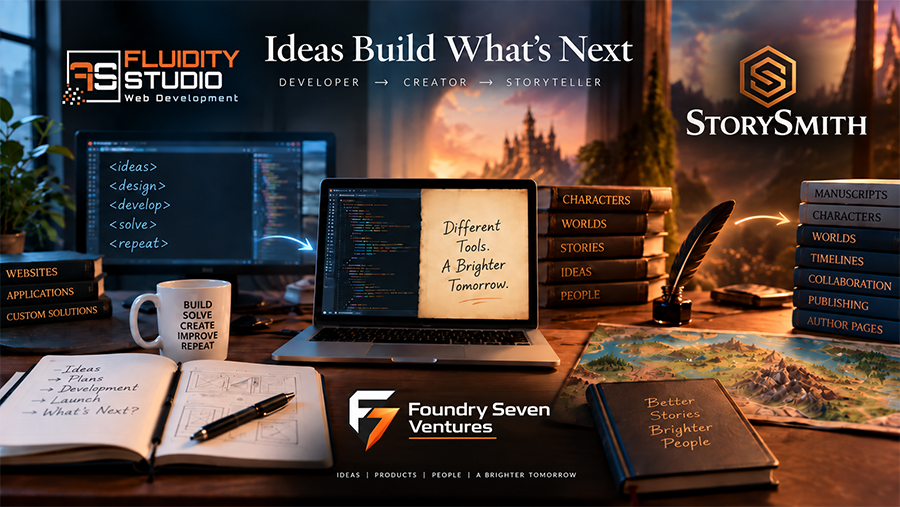
For more than two decades, Fluidity Studio has been where I build things.
Websites. Applications. Custom systems. Ideas that start as a conversation or a problem and eventually become something people can actually use.
StorySmith began the same way — except this time, I wasn’t building it for a client.
I was building something I wished existed.
What started inside Fluidity Studio as an original software project eventually grew into something much larger: a complete fiction-writing and worldbuilding platform, and ultimately one of the ventures that helped shape the direction of Foundry Seven Ventures.
Today, StorySmith is a Foundry Seven Ventures product, while Fluidity Studio remains the development business where the platform was originally conceived and built.
That distinction matters, because StorySmith represents a turning point in the kind of work I want to spend more of my time creating.
From Building for Clients to Building Products
Fluidity Studio has always been centered around solving problems through web development.
Sometimes that means building a public-facing website. Other times it means developing a custom administrative system, database-driven application, automation, or functionality that doesn’t exist in an off-the-shelf product.
Over the years, that way of working changed how I look at software.
I rarely see an application only from the front end.
I’m thinking about what the user sees, but I’m also thinking about what is happening behind it:
- How should the information be structured?
- What should happen automatically?
- Where does the user get confused?
- What can be simplified?
- How should one feature communicate with another?
- What information should already be available so the user doesn’t have to enter it again?
- How do you make something powerful without making it feel complicated?
Those questions became especially important when I began working on StorySmith.
The Problem StorySmith Was Built to Solve
Writers have no shortage of software available to them.
The problem is that much of the writing process is fragmented across different tools.
A writer might draft a manuscript in one application, keep character notes somewhere else, use another platform for worldbuilding, another for timelines, another for maps, another for editing, and yet another when it is time to collect feedback or prepare the manuscript for publication.
Then, after the book is finished, the author may still need a separate website or service just to create a public author presence.
I kept coming back to the same question:
Why should one story require so many disconnected platforms?
That became one of the guiding ideas behind StorySmith.
StorySmith was designed around keeping the creative process connected.
Building a Connected Writing Workspace
StorySmith has grown far beyond a basic manuscript editor.
Writers can develop and manage their stories while keeping the supporting pieces of those stories connected inside the same workspace.
That includes tools for:
- manuscript writing and organization
- detailed character development
- worlds and locations
- worldbuilding and visual atlases
- timelines and story planning
- notes and story information
- collaboration
- private beta-reader feedback
- publishing and export
- public author pages
Instead of treating each of those as an unrelated tool, the goal is for them to work as parts of the same creative environment.
A character isn’t simply a note in an unrelated database.
A location isn’t just an image saved somewhere on a computer.
A world isn’t a separate file the writer has to remember to reference.
Those elements belong to the story, so StorySmith was built to treat them that way.
Creating Structure Without Taking Control Away From the Writer
One of the most important decisions behind StorySmith was that the platform should provide guidance without taking over the creative process.
Writers don’t necessarily need another blank database that requires them to build their own writing system before they can start using it.
StorySmith guides writers through developing their characters, worlds, locations, and stories with structured fields and connected tools.
At the same time, the writer remains the author.
That philosophy also shaped Quill, StorySmith’s optional AI writing coach.
Rather than designing AI to replace the writer or generate an entire novel on their behalf, Quill is intended to assist the creative process.
It can help writers brainstorm, examine grammar and clarity, review chapters, analyze story elements, work through ideas, and provide another perspective when a writer gets stuck.
The goal is not to hand the story over to AI.
The goal is to give the writer another useful tool inside the workspace they are already using.
Bringing Visual Worldbuilding Into the Writing Process
Storytelling is not always purely textual.
Sometimes seeing a character, location, or fictional world can trigger ideas that did not exist before the image was created.
That led to visual character and location tools inside StorySmith, as well as the World Atlas.
A writer can develop the details of a fictional world and create a visual atlas that becomes part of that same project.
Locations can then be connected to the world rather than existing as unrelated images or notes.
The Atlas is continuing to evolve, but the underlying idea has remained the same:
visualization should support storytelling, not become another disconnected task.
Collaboration Without Giving Everyone the Keys
Collaboration became another area where the traditional writing workflow often felt unnecessarily fragmented.
StorySmith supports co-authoring and collaboration for writers who need another person actively working inside the project.
But not everyone who reads a manuscript needs that level of access.
That led to the addition of private beta-reader links.
An author can share either an individual chapter or an entire manuscript through a private link, allowing a beta reader to read the work and leave feedback without becoming a co-author or gaining access to the writer’s entire workspace.
It solves a very specific problem:
Writers should not have to export their work into another platform simply because they want someone to read it.
From Draft to Publication
Another important step was making sure StorySmith did not stop being useful when the manuscript was finished.
Publisher Studio was created to help writers prepare their work for the next stage.
StorySmith currently supports manuscript export into formats including:
- EPUB
- DOCX
- print-ready output
That means the same platform used to develop the characters, build the world, organize the story, write the manuscript, and collect feedback can also help prepare the finished work for publication.
Giving Authors a Public Home
One of the newest major additions to StorySmith is Author Pages.
For many independent or emerging authors, building and maintaining a completely separate author website may be unnecessary, expensive, or simply another task they do not want to manage.
StorySmith Author Pages give writers a public-facing place to present themselves and their work.
Authors can showcase:
- published and upcoming books
- purchase links
- author biography
- reader reviews
- events and book signings
- author blog posts
- newsletter signup
- release-notification subscribers
- social and contact links
The author enters the information.
StorySmith builds the page.
That is the same design philosophy used throughout the platform: give the user structure and useful tools without forcing them to become a web designer or software expert.
Where Foundry Seven Ventures Enters the Story
StorySmith began inside Fluidity Studio because Fluidity Studio was where I had always developed digital products.
But as StorySmith grew, something else became clear.
I wanted to build more products of my own.
That direction eventually led to Foundry Seven Ventures, which now serves as the venture company behind StorySmith and other original projects.
Fluidity Studio continues as my web development business and remains an important part of the story because it is where the technical foundation and development experience behind these products came from.
Foundry Seven Ventures represents where those skills are now being applied toward creating and growing products of my own.
StorySmith is one of those products.
All That Mystery is another — a very different platform centered around murder mystery games and interactive entertainment.
Different products. Different audiences.
But both grew out of the same habit that has driven Fluidity Studio for years:
find a problem, understand how people actually use something, and build a better way to do it.
More Than a Writing App
I don’t think of StorySmith as simply another writing application.
The long-term goal is larger than that.
StorySmith is being built as a connected creative environment where a writer can move from the earliest idea through development, writing, feedback, publication, and eventually their public identity as an author.
There will always be room to improve it.
Some of those improvements will come from ideas I have while building.
Others will come from the writers who use it and tell me what they need.
But the philosophy behind the platform is unlikely to change:
Writers should spend their time creating stories — not managing a collection of disconnected tools.
That idea started as a Fluidity Studio project.
Today, it is becoming something much larger through Foundry Seven Ventures.
And StorySmith is still being forged.
About the Companies
Fluidity Studio is the web development business where StorySmith was originally conceived and developed.
Foundry Seven Ventures is the venture company that now owns and operates StorySmith and other original digital products.
StorySmith is an all-in-one fiction-writing and worldbuilding platform designed to help writers develop, organize, write, revise, publish, and share their stories from one connected workspace.